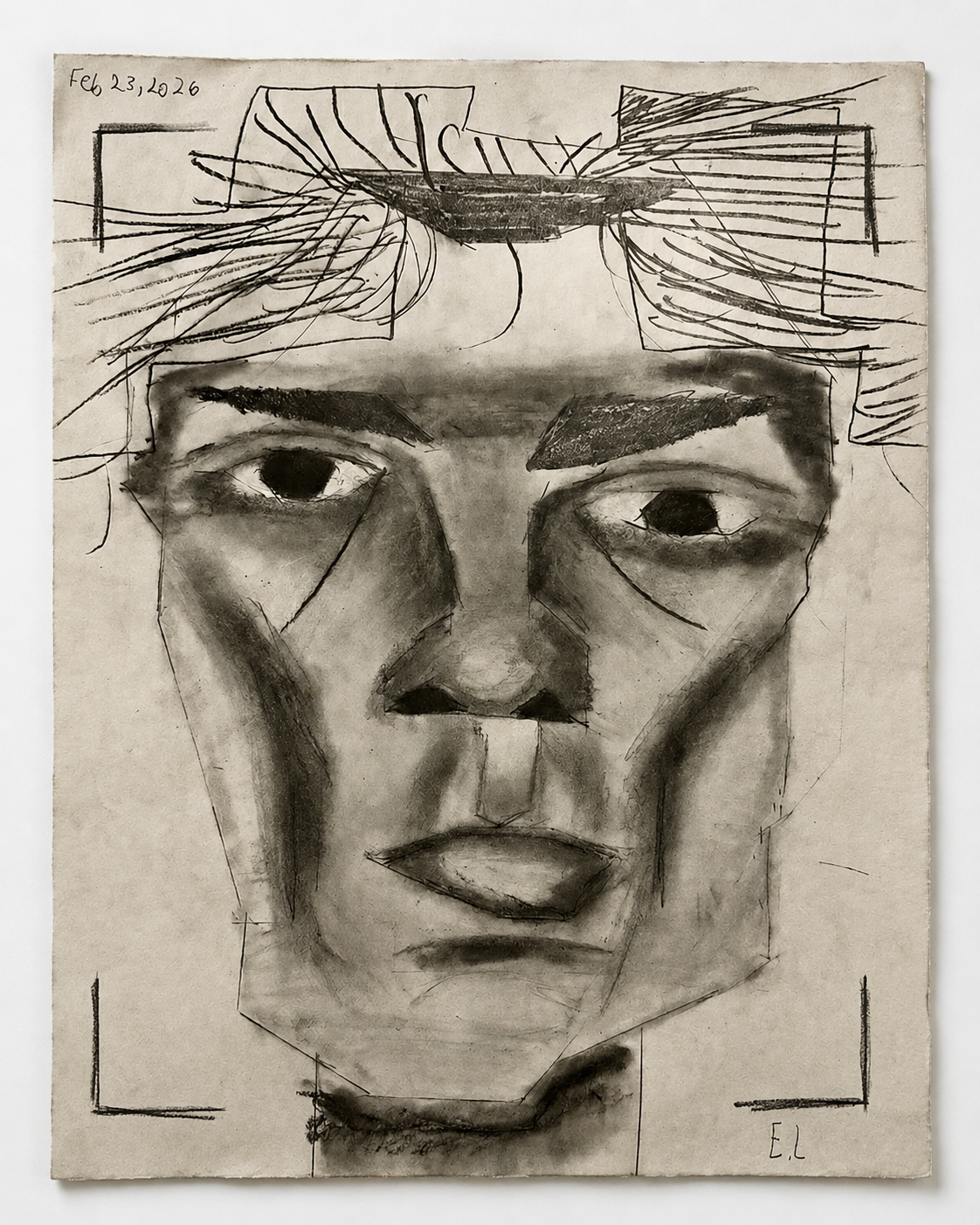
This piece moves from screen glow into the idea of being measured. I used my face as the subject, but I changed it into something more mapped and calculated. This drawing taught me that a face can feel more intense when it is not smoothed out or made flattering. I had to accept the hard lines, the heavy shadows, and the uncomfortable parts instead of trying to make the portrait look cleaner. The deep eyes, dark eyebrows, sharp nose, and hollow areas under the cheekbones gave the face more psychological weight, almost like it was staring back but not fully present. I also learned that the details around the face matter as much as the face itself. The wild lines at the top, the crop marks in the corners, and the geometric planes make the drawing feel like it is being scanned, framed, or broken down. It became less of a normal portrait and more of a persona piece, where self image, self scrutiny, and digital measurement all overlap. The hardest part was keeping the chaos controlled. If the hair and tracking lines were too neat, the drawing lost energy. If the face was too messy, the structure disappeared. The strongest part ended up being that tension between the calculated face and the parts that feel like they cannot stay contained.
I built the face with contour, geometric mapping lines, and tonal shading. The structure came first because the drawing needed to feel measured. I used straighter lines around the jaw, cheeks, eyes, and nose so the face would look partly broken into sections. The shading then worked against that structure by making some areas softer and more human. That contrast was important. If everything was only geometric, the drawing would feel like a mask. If everything was only blended, the idea of mapping would disappear. The top of the head has more loose, linear movement, almost like wires or scanning marks, which helps connect the face to technology without adding an actual phone or screen. The dark eyebrows and eyes became the strongest anchors because they make the face stare back.
This drawing taught me that distortion works better when it still has a base of observation underneath it. I could not just make the face angular randomly. The proportions, shadows, and facial features still had to be believable enough for the distortion to feel intentional. I also learned that lines can have different jobs in one drawing. Some lines describe the form, some divide the face, and some feel more like tracking or measurement. That made the drawing more layered than I expected. The hardest part was balancing the personal side with the social idea. I wanted it to feel like me, not just a generic face being scanned. The imperfections and tired expression helped with that because they kept the drawing from becoming too clean or futuristic.