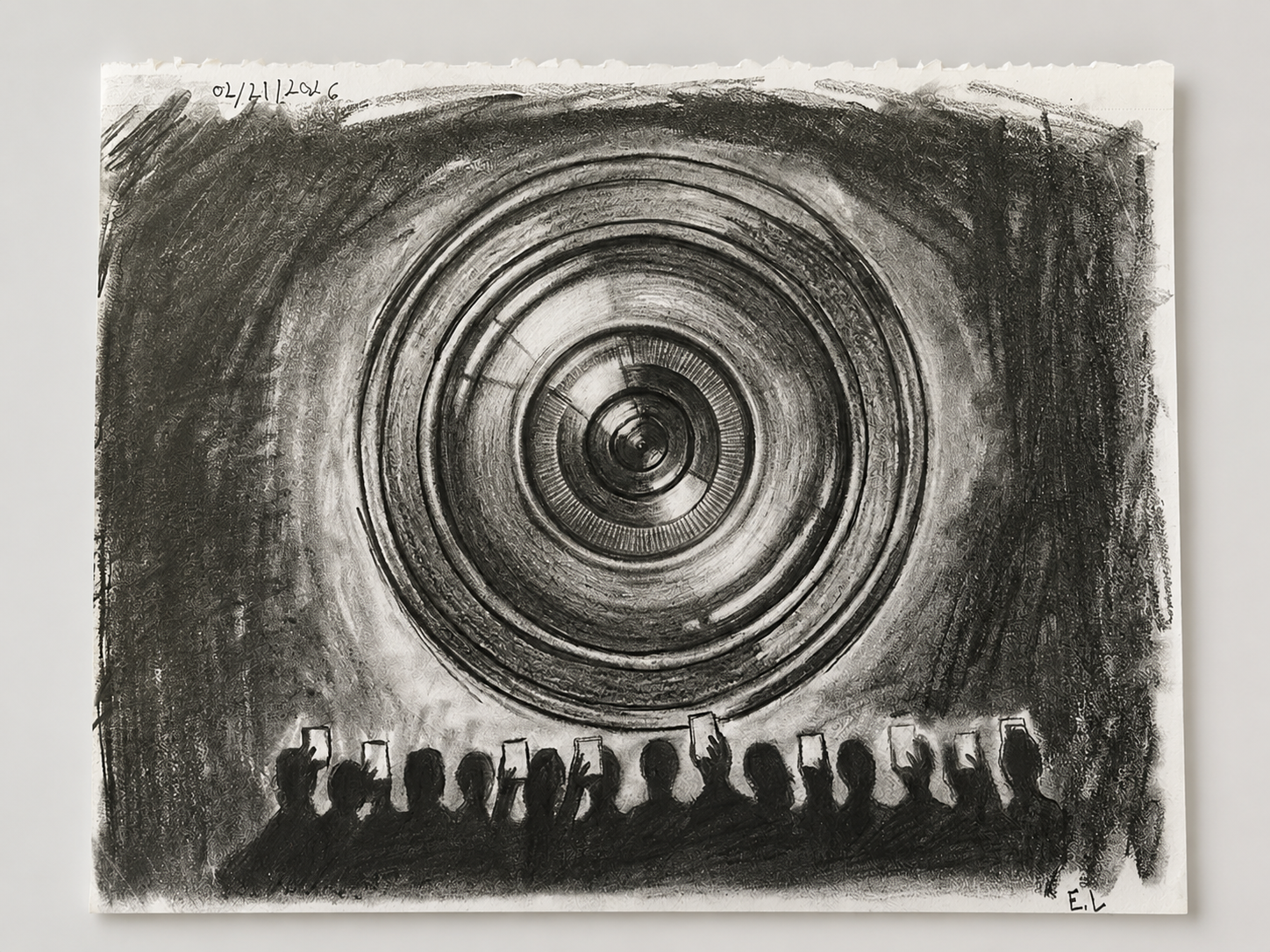
The last drawing expands the series from private technology to public surveillance. Instead of one phone or one face, I drew a crowd under a large circular eye or camera lens. The people at the bottom are simplified into silhouettes, and many of them are holding up phones. That choice was important because they are not only being watched, they are also participating in the watching. This drawing connects to the idea of the Panopticon, where people change their behaviour because they feel like they could be watched at any time. I related that to crowded public spaces and the anxiety of feeling like just one more target inside a system.
I made the lens much larger than the crowd so the scale would feel unfair. The circular form is controlled and almost mechanical, while the people below are dark, small, and crowded together. I used hatching, stippling, scribbling, and gesture like marks to build the background and make the space feel noisy. The crowd was kept mostly black because individual identity was not the focus here. The phones create small repeated shapes, but the strongest part is still the giant eye above them. I worked with concentric rings and darker shading inside the lens to pull the viewer toward the center. Around it, the rough graphite creates a white noise feeling, like visual static or pressure around the scene.
This drawing made me think about composition as power. The image works because the lens dominates the page and the people are pushed down into a narrow band. I learned that scale can say a lot before the viewer even reads the details. Making the crowd smaller made them feel more vulnerable, and making the eye larger made the whole space feel controlled. I also learned that repetition can create unease. The repeated phones, heads, rings, and scratchy marks build a pattern that feels organized but also unsettling. Compared to the first drawing, where one phone sits quietly on a table, this final piece shows what happens when that same kind of attention becomes collective and public. It ends the series by making the private habit feel part of something much larger.