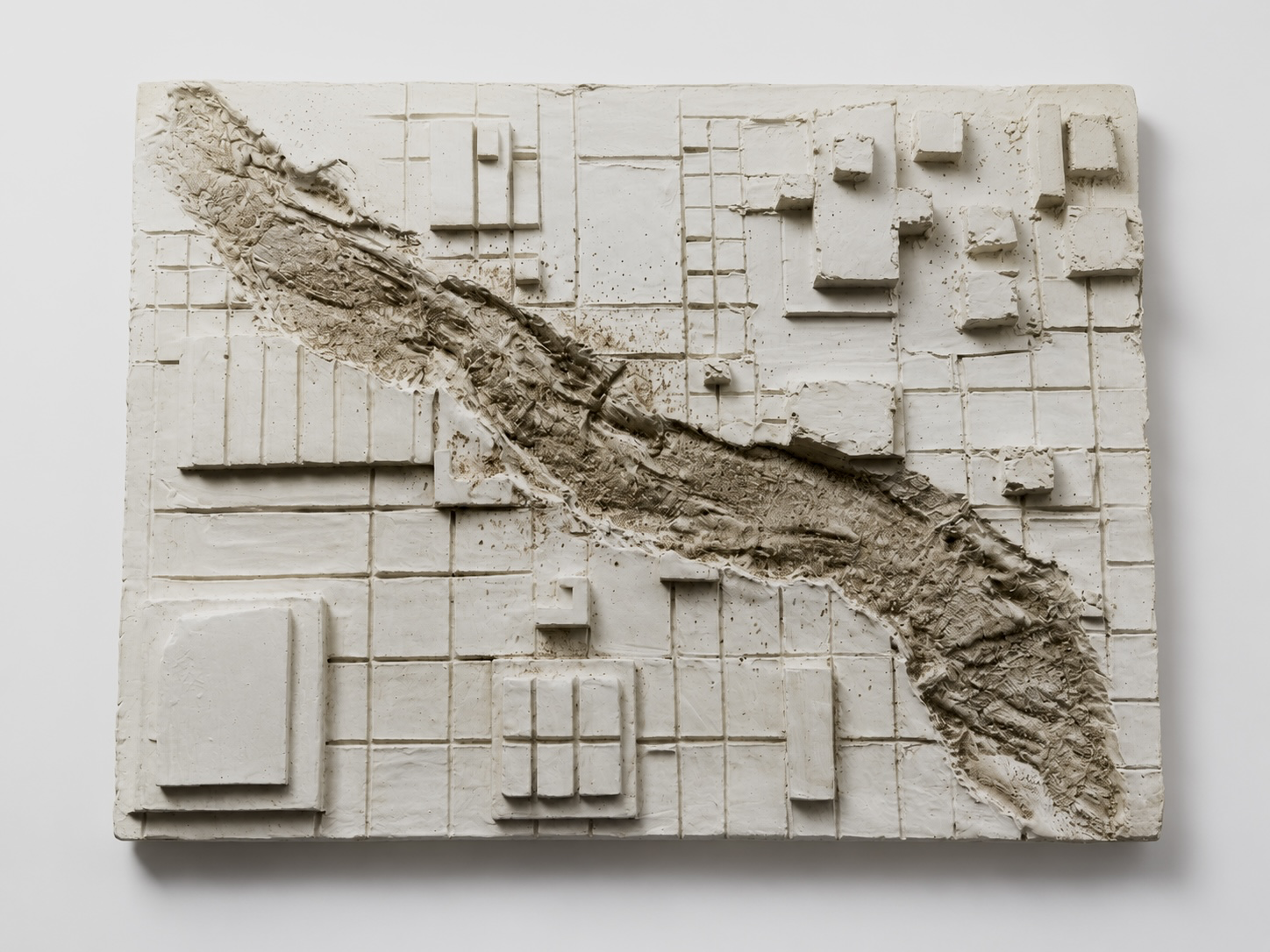
The starting point for this piece was the idea of a desire path. I was interested in those unofficial trails people make when they stop following the planned route and just move in the way that makes the most sense to them. For the design problem, I wanted to show that kind of movement without actually showing a person walking, footprints, or a body. The grid became the planned system, something controlled and organized, while the diagonal path became the part that slowly wears through it. I also connected this to ideas from Yevgeny Zamyatin’s We, where straight lines and perfect order are treated like the ideal, and anything irregular feels almost dangerous. That helped me think of the path as something human pushing against a system that wants to stay untouched.
I used powdered plaster for the grid because it could be cast into cleaner, harder plates. That smoothness mattered because the grid needed to feel official and designed, not handmade in the same way as the path. For the path, I used plaster gauze because it behaved completely differently. It could bunch up, fray, thin out, and expose its mesh, which made it feel more like wear than a clean cut. During the tests, I realized that if the path was too clear or too thick, it started looking like another planned design. The stronger version was more uneven: shallow in some areas, rougher in others, with the grid still partly visible underneath. I added sand at the end because the path needed that dusty, rubbed-down feeling instead of looking too soft or decorative.
The biggest thing I learned was that the sculpture worked better when the damage was controlled, not when it looked completely destroyed. If the grid disappeared too much, there was no tension left. If the path was too neat, it looked intentional in the wrong way. The best areas were where the grid almost survived but had clearly lost control. I also learned that material can solve part of the idea for you. The plaster gauze made the concept more believable because it naturally frayed and resisted being perfect. It was messy and dried faster than I expected, but that actually fit the piece. The path needed to feel like something that happened over time, not something I simply drew on top.